





Interprofessional Education Is Required. Almost No One Delivers It With Real Patients.
Every Accreditor Requires It. Most Programs Simulate It.
Healthcare is delivered by teams. Accreditors know this, and they have written it into their standards.
ARC-PA Standard B2.10 requires PA curricula to prepare students to work collaboratively in interprofessional patient-centered teams. The standard names three components: content on the roles and responsibilities of various healthcare professionals, emphasis on the team approach to patient-centered care, and application of these principles in interprofessional teams.
The AACN Essentials devote an entire domain to it. Domain 6, Interprofessional Partnerships, sits alongside nine other domains that CCNE requires nursing programs to incorporate. The Interprofessional Education Collaborative maintains core competencies that programs across medicine, nursing, pharmacy, and allied health map their curricula against.
The requirement is settled. The delivery is not.
Ask a program director how their students meet interprofessional competencies, and the answer is usually a simulation lab, a shared case discussion, a panel event, or a joint didactic session. These are legitimate educational activities. They are also, in most cases, the only interprofessional exposure a student gets before graduation.
Students learn team-based care by reading about teams. Then they graduate into one.
Why Real Interprofessional Practice Is Structurally Hard
The gap is not a failure of intent. Programs want students practicing alongside other disciplines. The logistics make it nearly impossible.
A traditional clinical site would need students from multiple professions rotating at the same time, in the same department, on the same patients. Those students typically come from different institutions with different academic calendars, different rotation lengths, different learning objectives, and different competency frameworks. The site would need to coordinate all of it, and the preceptor would need to supervise learners at different levels of training across different professions simultaneously.
Most sites cannot do this. Many struggle to host one student from one program.
The result is that interprofessional education gets satisfied on paper while the clinical year stays siloed. PA students rotate with PAs. Nursing students rotate with nurses. They meet each other after graduation, in a hospital, with a real patient in front of them.
How Interprofessional Rotations Work on MomentMD
Every university program operates on one platform. That changes what is possible.
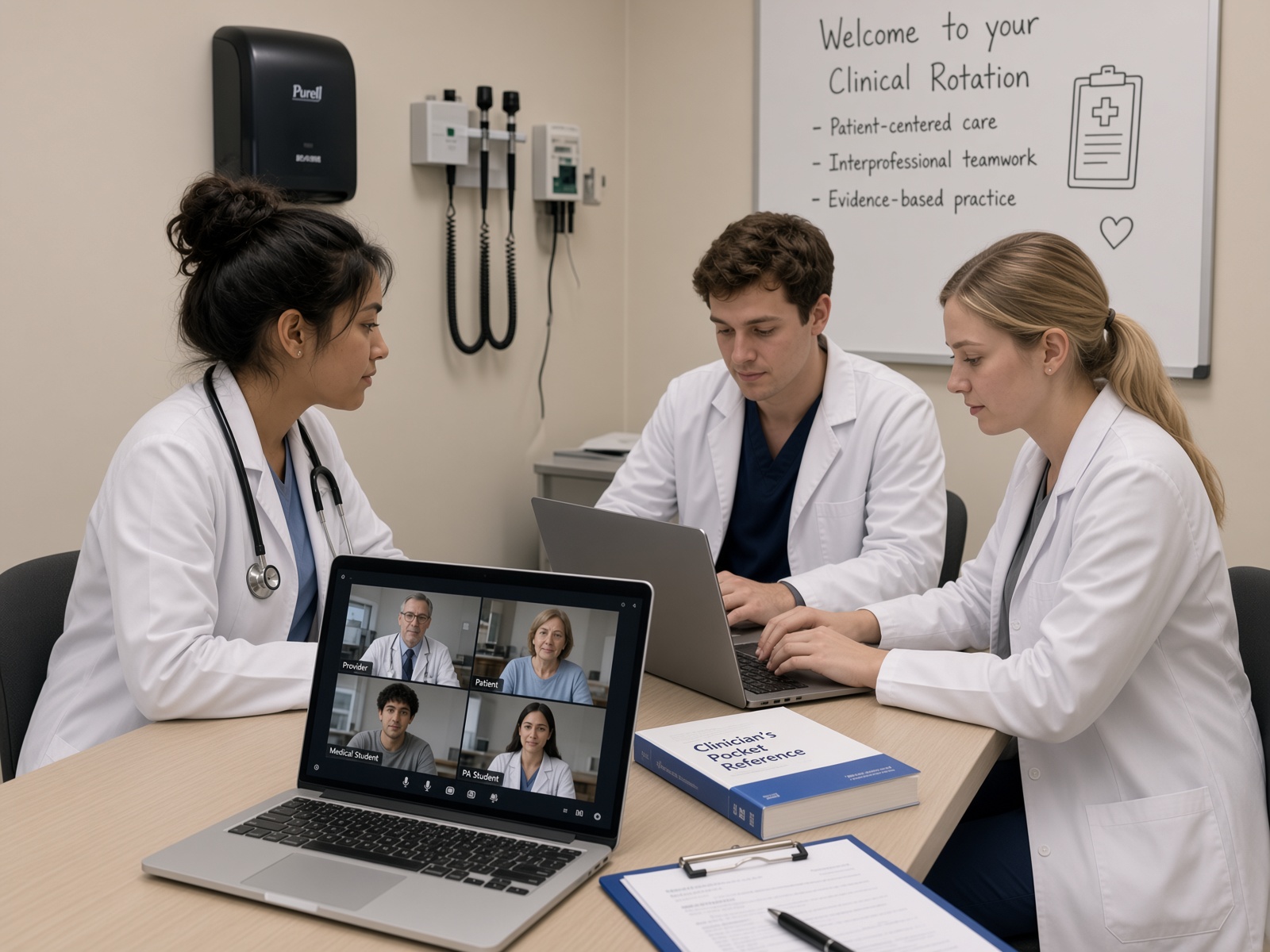
A PA student from one institution and a nursing student from another can be scheduled into the same telehealth encounter, with the same patient, under the same board-certified preceptor. A PA student and a medical student can work a case together. The pairing is a scheduling decision, not a logistical impossibility, because both students already exist in the same system.
What happens inside the encounter mirrors clinical practice. Students divide responsibilities the way a real team does. One leads the history. Another builds the assessment. They negotiate the plan, document their portions, and defend their reasoning to the preceptor and to each other.
That last part matters. Explaining your clinical thinking to someone trained in a different discipline is the skill interprofessional competencies actually describe. It cannot be simulated convincingly, because in a simulation everyone knows the stakes are hypothetical. With a real patient, they are not.
Each Student Runs a Different Rotation Inside the Same Encounter
Two students in one encounter are not completing the same rotation. They should not be.
A PA student and a nursing student are accountable to different accreditors, different program objectives, and different competency frameworks. Evaluating them identically would fail both.
MomentMD’s AI engine builds each student’s rotation framework individually, drawing on three inputs.
The accreditor. A PA student’s framework maps to ARC-PA requirements. A nursing student’s maps to the AACN Essentials domains. The competencies a student is measured against reflect the body that will review their program.
The program’s objectives. Universities define their own learning outcomes on top of accreditor minimums. Those outcomes vary by institution and by track. The framework incorporates what the specific program requires of that specific student, in that specific rotation.
The student’s current performance. This is the input that makes the framework adaptive rather than static. A student who has demonstrated strong diagnostic reasoning but weaker documentation gets a framework weighted toward documentation. A student early in the clinical year gets different scaffolding than one approaching summative evaluation. The framework moves as the student does.
The preceptor sees one encounter. The platform runs two distinct evaluation structures underneath it, each aligned to the student it belongs to.
What This Produces
Three outcomes follow from the design.
Interprofessional competencies get met through practice rather than proxy. Programs can document that students worked in interprofessional teams on real patient encounters, with defined learning outcomes and faculty evaluation. That is a materially stronger accreditation artifact than attendance at a joint didactic session.
Students graduate having already done the thing. The first time a new PA works alongside a nurse on a shared patient should not be their first week of employment. Interprofessional rotations move that experience into training, where a preceptor is watching and feedback follows.
Evaluation stays discipline-appropriate. Shared encounters do not mean shared standards. Each student is assessed against the framework their profession, program, and progress require.
The Bottom Line
Interprofessional education is not an emerging idea. It is a standing requirement across MD, DO, PA, Nursing accreditation, and it has been for years.
What has been missing is a way to deliver it with real patients at scale. Simulation labs and case discussions were never the goal. They were what the logistics allowed.
The logistics have changed.