





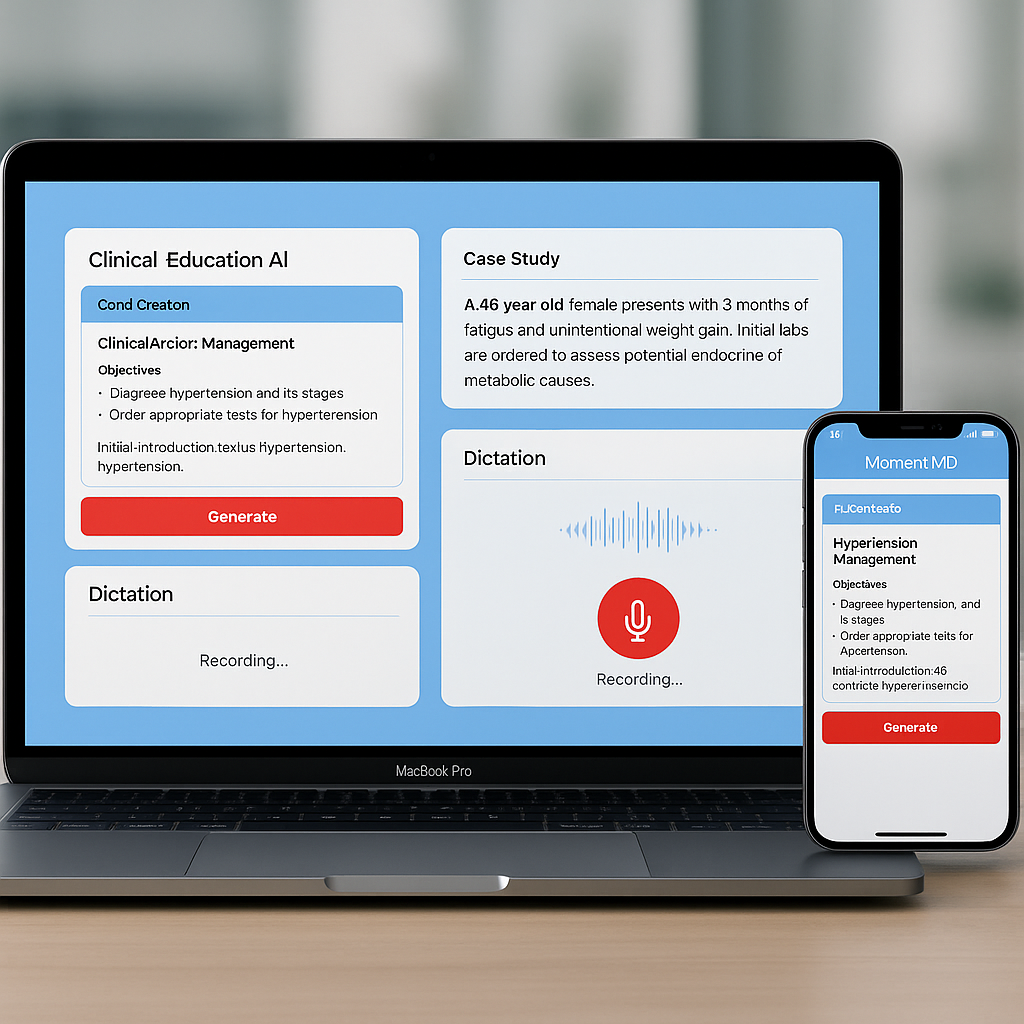
The landscape of clinical education is changing rapidly. Medical students, physician assistant trainees and nursing students are no longer confined to brick–and–mortar clinics; they’re navigating virtual encounters, interacting with AI and honing digital competencies that will define modern practice. MomentMD sits at the intersection of telemedicine and artificial intelligence. Its platform pairs students with preceptors through live virtual clinics and layers in AI–powered tools that streamline documentation, personalize learning and prepare students for a new era of healthcare.
Dictation AI: Freeing Hands and Minds
Recording clinical encounters has traditionally meant scribbling notes or typing in an electronic health record. That process is cognitively demanding and often distracts from the patient interaction. MomentMD’s telemedicine rotations leverage AI–powered medical dictation. Instead of typing, students speak naturally during virtual visits. The AI listens, transcribes and structures the note, capturing the patient’s narrative while the student stays fully engaged. This hands–free approach cultivates empathy and improves accuracy in documentation, while simultaneously exposing students to the ambient listening technology they’ll encounter in modern clinics. As one of MomentMD’s blog posts notes, embracing dictation AI during rotations “facilitates a more nuanced, efficient form of record–keeping”.
Benefits
- Patient–centred encounters. With AI handling the note, students can focus on listening and building rapport rather than keeping up with typing.
- Efficiency and accuracy. Transcribed notes reduce the chance of missed details and mirror the ambient documentation systems entering mainstream practice.
- Early exposure to AI. Learning dictation tools within a supervised environment builds confidence and demystifies AI for future clinicians.
Workflow AI: Smart Documentation & Scheduling
MomentMD’s platform doesn’t stop at dictation; it embeds AI into workflow management. Students learn to work with AI–powered workflows, dictation tools and smart documentation systems. The platform automates routine tasks: scheduling rotations, verifying licensure and recording evaluations, so faculty and students spend less time on logistics and more on learning. Integration of AI–powered documentation and e–prescribing simulations streamlines the clinical encounter. Faculty dashboards display compliance, evaluations and hours completed, reducing administrative burden and ensuring that accreditation requirements are met.
Impact on Programs
- Improved exam performance and retention. Programs using MomentMD’s teleprecepting model report average end of rotation exam scores increasing by about 70 points. The platform’s efficiency and feedback loops translate into better preparation for board exams.
- Operational gains. Universities experience 60 % faster placement times and 30 % fewer graduation delays thanks to automated scheduling and centralized oversight.
- Scalable capacity. By removing geographic barriers and automating placement, programs can accept more students without relying on local clinic space.
AI–Generated Learning Content: Tailored to Syllabi and Objectives
Clinical rotations should be more than logging hours; they should reinforce didactic knowledge and sharpen core competencies. MomentMD recently introduced a content engine that builds custom courses around each program’s syllabus and rotation objectives. During rotations, students have access to rotation specific educational content: flashcards, quizzes, podcasts and interactive case studies tailored to their specialty. This integration creates a feedback loop: students see cases, then reinforce their understanding with targeted study materials.
The personalization is powered by generative AI and adaptive learning principles. MomentMD’s 2025 clinical education trends report describes the development of virtual rotations where AI augments patient encounters and uses a large language model to score the learner’s performance and provide immediate feedback. Elsewhere, programs are embracing AI platforms that generate adaptive case–based questions from lecture materials, identifying knowledge gaps and recommending tailored content. MomentMD’s content engine follows this trend: by ingesting a program’s syllabus and accreditation requirements, it assembles micro-learning modules that emphasize topics required by accrediting bodies while focusing on the student’s weak areas. Data from quizzes and case analyses feed back into the system, allowing it to adjust the difficulty and focus for each learner.
Why Adaptive Learning Matters
- Precision education. Data analytics identify where students struggle and push relevant materials to close those gaps.
- Alignment with accreditation. Content draws from rotation objectives and standards set by bodies such as AAMC, COCA, CCNE, or ARC–PA, ensuring that students meet required competencies.
- Engagement through variety. Mixing podcasts, flashcards, lectures and quizzes caters to different learning styles and keeps students motivated.
Preparing Students for Exams and Digital Practice
Telemedicine rotations aren’t just clinical experiences; they’re comprehensive preparation for board exams and modern practice. MomentMD’s approach combines live cases with structured study:
- Real time case presentations and virtual study sessions allow students to dissect complex scenarios, ask questions and receive immediate feedback. This interaction fosters critical thinking and reinforces exam relevant content.
- Exposure to diverse specialties: from primary care and mental health to pediatrics and dermatology, broadens students’ knowledge base and helps them apply theory across contexts.
- Rotation–specific content and adaptive quizzes sharpen recall and application skills, helping students “crush their rotation” and improve their test scores.
Evidence of Success
Programs partnering with MomentMD have documented tangible outcomes. Graduate students complete rotations on time and demonstrate stronger exam performance. The integrated AI tools also lead to better faculty oversight and fewer administrative bottlenecks.
Personalizing Rotations for Growth
Every student enters clinical training with unique strengths and weaknesses. AI allows MomentMD to tailor experiences accordingly:
- Adaptive scheduling. The platform can prioritize rotations in specialties where a student needs more exposure, ensuring they meet core competencies and personal interests.
- Customized content sequencing. If quizzes reveal a weak understanding of, for example, pharmacology, the AI engine surfaces extra flashcards and podcasts on that topic while maintaining focus on the syllabus and accreditation requirements.
- Feedback–driven adjustments. Performance scores from real patient visits inform adjustments to the learning plan. Students can practice communication and diagnostic reasoning until they’re confident.
By continuously adapting to the learner, MomentMD’s AI tools transform rotations into personalized journeys rather than one–size–fits all experiences.
Conclusion: A Blueprint for the Future of Clinical Education
Healthcare is becoming increasingly digital, and clinical education must evolve in parallel. MomentMD’s platform illustrates how AI–powered dictation, workflow automation and adaptive content engines can address the preceptor shortage while raising educational quality. Students trained with these tools gain more than clinical hours; they develop digital literacy, improve exam readiness and engage in self directed learning. By aligning content with program objectives and accreditation standards, the platform ensures compliance while nurturing individual growth. As AI continues to advance, expect the line between clinical practice and education to blur even further, creating a workforce prepared to deliver compassionate, data driven care wherever their patients are.