





The Enrollment Arms Race Has a New Frontline
If you’re a dean or program director at a graduate medical, nursing, or PA program, you already know the enrollment landscape has shifted. Students are savvier, more researched, and more outcomes-focused than ever before. They’re comparing programs not just on tuition, faculty credentials, or USMLE pass rates, they’re asking a question that would have been unthinkable a decade ago:
“Can your program guarantee me clinical placements?”
And increasingly, the programs that can answer “yes” confidently and quickly, are the ones winning the enrollment battle.
Here’s why virtual clinical rotations are becoming the single most powerful enrollment differentiator for graduate health programs, and what it means for institutions that haven’t adopted them yet.
The Placement Crisis Is Now an Enrollment Crisis
The data paints a stark picture. According to the American Association of Colleges of Nursing (AACN), more than 65,000 qualified nursing applicants were turned away from baccalaureate and graduate programs in 2023. The primary barriers? Insufficient clinical placement sites, faculty, and preceptors.
This isn’t just a supply problem, it’s a demand signal. Students know that getting into a program is only half the battle. Getting through it on time is the other half, and clinical placements are the bottleneck.
In PA education, 95% of program directors report concern about the availability of clinical training sites. Over half of PA programs now pay hospitals or preceptors for rotation slots, with some spending upwards of $200,000 annually, costs that inevitably trickle down to students. For MD and DO programs, 84% of medical school deans reported concern about clerkship site availability even before the pandemic, and nearly 9 in 10 struggle to secure enough primary care preceptors.
When students hear these numbers and they do, through forums, Reddit threads, and peer networks, they start making program decisions based on one critical factor: clinical placement reliability.
What Today’s Students Actually Want
The best prospective students aren’t just looking for prestige or location anymore. They’re asking practical, career-focused questions during their program evaluations:
“How quickly can you confirm my rotations?” Students who’ve heard horror stories about classmates cold-calling dozens of clinics are drawn to programs that can confirm placements months in advance or even up to 12 months out.
“Will I graduate on time?” Delayed graduation means additional tuition, lost income, and delayed entry into the workforce. Programs that can demonstrate on-time graduation rates tied to guaranteed placements have a significant edge.
“Will I learn telehealth?” This one is newer, but growing fast. AAMC data shows that over 50% of the Class of 2025 completed at least one clinical away rotation, and most students used their clerkship experiences to finalize career specialty decisions. Students are increasingly aware that telehealth competency isn’t optional, it’s expected by employers. The AAMC, ARC, and AACN have both published telehealth competencies, signaling that virtual care skills are now core to clinical education.
“Does the program fit my life?” Many graduate health students are working professionals, parents, or career changers. They need flexibility. A program that offers 24/7 scheduling for virtual rotations alongside traditional in-person placements becomes dramatically more attractive to this growing demographic.
Virtual Rotations: From Pandemic Stopgap to Competitive Advantage
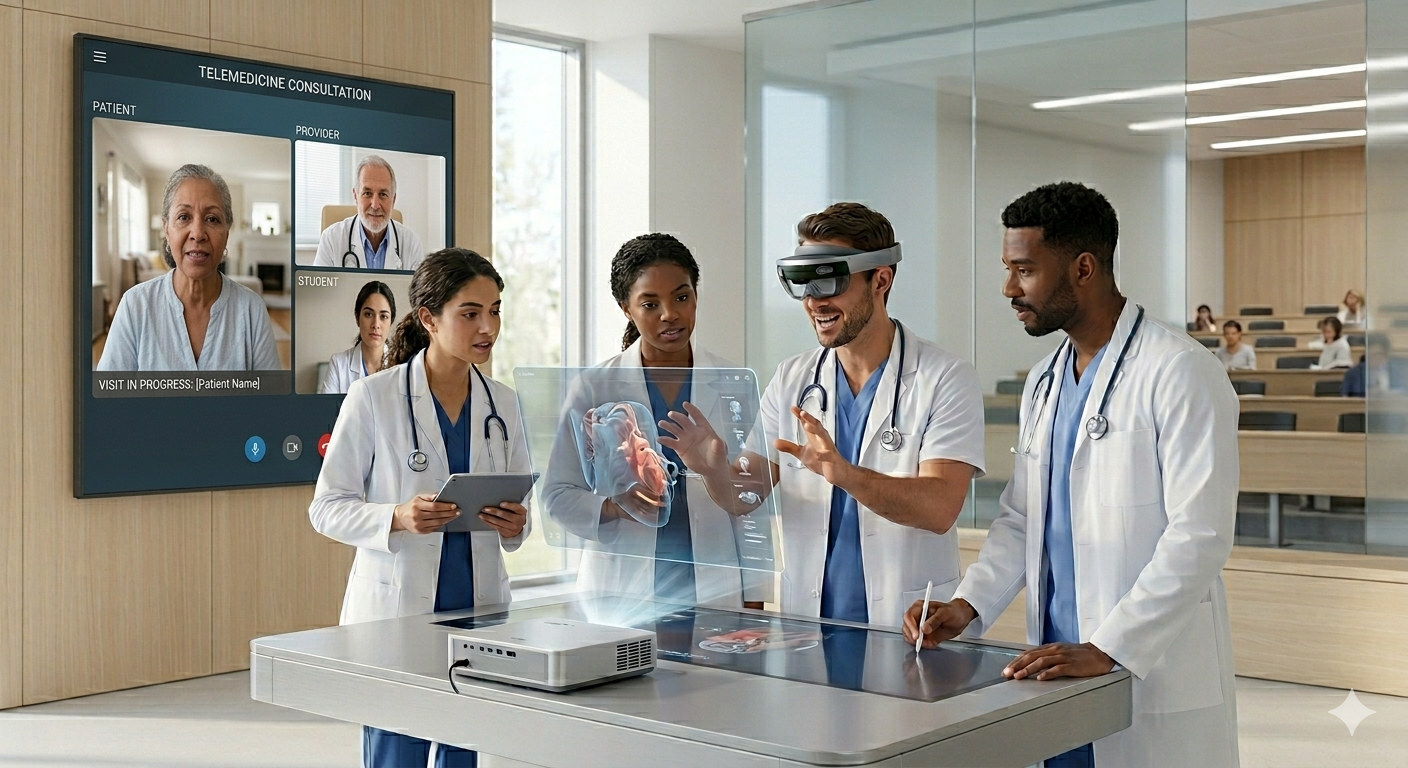
When telehealth rotations first emerged during COVID-19, many viewed them as a temporary workaround. That perception has fundamentally changed.
In 2022, 86.9% of U.S. hospitals offered telehealth services, up from 72.6% in 2018. Telehealth is no longer emergency medicine’s backup plan, it’s a core delivery model. And employers expect new graduates to be proficient in it.
Programs that have integrated virtual clinical rotations are now reporting tangible enrollment advantages:
Expanded geographic reach. An NP program in rural Appalachia can now offer its students rotations with board-certified psychiatrists in New York or pediatricians in California. Geography is no longer a constraint on program quality or student recruitment. This is especially powerful for online and hybrid programs competing for students nationally.
Elimination of placement anxiety. When a program can tell a prospective student “we guarantee your rotations across all required specialties,” that’s a fundamentally different conversation than “we’ll help you find placements.” The former closes enrollments. The latter creates doubt.
Specialty access that was previously impossible. Mental health rotations are notoriously difficult to secure, 50% of U.S. counties lack a psychiatrist. Women’s health and specialty electives like dermatology or endocrinology are similarly constrained. Virtual precepting networks solve this by connecting students to specialists regardless of location.
Higher retention through flexibility. Students who can complete clinical hours around their existing commitments; evening shifts, family obligations, employment, are less likely to drop out, take leaves of absence, or extend their programs. Higher retention means better cohort outcomes, which means better accreditation standing, which means better enrollment numbers. It’s a virtuous cycle.
The Enrollment Marketing Angle No One Is Talking About
Here’s what makes this a true competitive differentiator: most programs haven’t adopted virtual rotations yet. The institutions that move first are capturing an outsized share of the most motivated, outcomes-oriented students.
Consider the enrollment funnel. A prospective NP student is evaluating three programs:
Program A says: “We have partnerships with local hospitals for clinical placements.” (Translation: We hope we can place you, but no guarantees.)
Program B says: “We provide resources to help you find preceptors.” (Translation: You’re on your own.)
Program C says: “We guarantee placements across six specialties, including mental health and primary care, with confirmed schedules up to 12 months in advance. Our students also graduate with telehealth competency that employers are actively seeking.” (Translation: We’ve solved the biggest problem in clinical education.)
Which program is that student choosing?
This isn’t hypothetical. Programs partnering with platforms like MomentMD, which has placed students at over 40 institutions including Johns Hopkins, Purdue, and Marquette, are already using guaranteed virtual placements as a headline feature in their recruitment materials.
What This Means for Your Program
If you’re a program director reading this and thinking “we should be doing this,” here are the practical implications:
Your admissions team needs to lead with placement guarantees. Every open house, every campus visit, every digital ad should answer the clinical placement question before students even ask it. If you can guarantee rotations, say it loudly. If you can’t yet, that’s the gap to close.
Online and hybrid programs have the most to gain. These programs already attract students who value flexibility. Adding virtual rotations to your clinical education model isn’t a departure from your brand, it’s the fulfillment of it. Students chose your program because of flexibility; extend that promise through graduation.
Accreditation bodies are watching. The AACN’s updated Essentials and the ARC-PA’s standards increasingly recognize telehealth as a legitimate and valuable training modality. Programs that integrate virtual rotations aren’t just meeting current standards, they’re positioning for where standards are heading.
The data supports the investment. Programs integrating structured telehealth precepting have reported faster placement times, fewer graduation delays, and improved exam performance. These aren’t just student satisfaction metrics, they’re the outcomes that drive rankings, accreditation, and enrollment.
The Bottom Line
The clinical placement crisis isn’t going away. Enrollment in health professions programs continues to grow, but the number of available preceptors and training sites hasn’t kept pace. Students know this, and they’re making enrollment decisions accordingly.
The programs that will thrive in the next decade are the ones that solve the placement problem, not by scrambling harder within a broken system, but by building new infrastructure that guarantees access, teaches modern care delivery skills, and fits the lives of today’s students.
Virtual clinical rotations aren’t a nice-to-have anymore. They’re the differentiator your best prospective students are looking for, whether you’re offering it or not.